
'India cannot speak of a demographic dividend if half its young women are unable to participate in paid work.'

At least six major UK universities have announced plans to set up campuses or liaison offices in India.

Top female executives are calling for corporate India to redesign workplace systems to support women's advancement into leadership roles in the technology sector, particularly in emerging fields like artificial intelligence.

'The reason why they rushed through the bill was they wanted to avoid using the 2026 Census because the 2026 Census by their own decision will be a caste census.' 'The BJP knows that a significant share of the OBCs who will get captured in the census, for the first time after the 1931 Census, are against the BJP. Only a segment of the OBCs are in their favour.' 'So they wanted to avoid the OBC reservation among women, which is a demand of a lot of Opposition parties.'

The coveted QS rankings indicate that India is slowly but steadily overtaking other nations in the field of education.

IMF Managing Director Kristalina Georgieva discusses the potential of artificial intelligence to boost global growth, particularly in India, while also addressing the significant risks of job displacement and financial instability.

The Supreme Court's stay on the UGC equity regulations aimed at preventing caste-based discrimination on campuses has been met with mixed reactions. Opposition parties welcomed the decision, while some expressed concern over the implications for marginalized communities.

A new report indicates a decrease in international student enrolments in US colleges, but India remains the top source of international students.

The Supreme Court has ruled that women Short Service Commission officers in the Army, Navy, and Air Force, who were unfairly denied Permanent Commission, are entitled to full pensionary benefits.
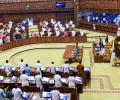
The Kerala Assembly passed a bill allowing for the establishment of private universities in the state. This marks a significant policy shift for the CPI(M)-led government, which had previously opposed privatization of education. The bill was passed by voice vote following discussions on Monday and Tuesday. The opposition raised concerns about the potential impact of private universities on public institutions and questioned the practicality of the requirements for starting a private university. However, the government defended the bill, stating it was a necessary step to improve higher education in Kerala and elevate public universities to global standards.
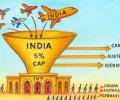
Trump's proposed policy limits undergraduates from any one country to 5% at select top US universities, raising concerns for Indian aspirants eyeing elite colleges.

Ask rediffGURU Naveenn Kummar your insurance mutual fund and personal finance-related questions.

Initially, we will look to take a small batch of a few hundred students, with a plan to increase this to 5,000 students in the next five years, and eventually 10,000 by 2036.'

'Our problem is not a budget deficit but a trust deficit. We need to trust our institutions and industries to innovate and lead. That is the way forward for India.'

While many areas compete for resources, defence, education, and adaptation deserve focus for maximum impact, suggests Laveesh Bhandari.

Capex, infrastructure development, and prudent fiscal management are the key focus areas in the Budget, says Nilesh Shah.

In tackling India's unemployment problem, look beyond the finance minister and focus on the education minister, points out Gurbachan Singh.

Uncertainty clouds US fall intake as Trump's visa ban on Harvard raises fears of wider policy shifts, pushing Indian students to explore alternative destinations.

This was perhaps a missed opportunity for India to spotlight a core domestic challenge: The scale of workforce preparation required for a young, populous, rapidly growing country seeking to reach net zero, points out Radha Roy Biswas.

Can change happen? Not unless the changemakers themselves want it since they benefit the most from the status quo, warns Biswajit Dasgupta.

The Union Budget for 2026-27, presented by Finance Minister (FM) Nirmala Sitharaman on Sunday, which was a first, had an excellent domestic macro backdrop. According to the first advance estimates, gross domestic product (GDP) in constant prices is projected to grow 7.4 per cent in the current financial year, against 6.5 per cent in 2024-25.

By giving students powerful tools early, these companies build long-term trust and affinity.

"Nations need to recognise higher education as the engine of economic growth and prosperity," says Dr Susan Aldridge, president, University of Maryland University College, US, Aziz Haniffa reports

Steps will be taken to attract external commercial borrowing and FDI in the education sector, the finance minister said. Stating that govt will soon introduce new education policy, Sitharaman said online degree courses to students from weaker sections.

Ask rediffGURU Naveenn Kummar your insurance mutual fund and personal finance-related questions.

The Indian government has expressed its disagreement with the IMF staff's 'baseline' assumption that the 50 per cent US tariffs on its goods exports 'would remain in place indefinitely', based on which the staff pegged the country's GDP growth at 6.6 per cent this year, and pared its 2026-27 projection by 20 basis points to 6.2 per cent.

Addressing a summit in Varanasi on the implementation of the National Education Policy, Modi said the system should not just produce degree-holders but provide human resources needed to take the country forward.

Across all sectors, the future of work depends on adaptability.
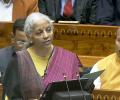
Budget 2026 sticks to fiscal discipline, shuns populist measures despite five key state elections coming up, but ends up rattling stock markets with a higher transaction tax on derivatives trading.

'In the long run, India's strong growth story and reforms to make assets globally attractive will determine the rupee's resilience.'

At the Mumbai campus the institute will offer both UG and graduate degrees, most of its courses will focus on science, technology, engineering and mathematics.

Younger customers should opt for increasing cover as their financial commitments are likely to rise in the future.

With stricter policies dampening the US/UK dream, Germany, Ireland and New Zealand are emerges as new study abroad destinations for Indian students.

The fiscal tilt towards capex benefits companies in investment-related sectors like capital goods, defence equipment, engineering & construction and metal & mining. The planned cut in revenue expenditure will weigh on companies in consumption sectors like FMCG, consumer durables and retail.

Sitharaman said the government will bring in a new national education policy to transform India's higher education system into one of the best in the world.

If they act now, they can reshape the strategic map of Asia without firing a shot. If they wait, the next opportunity will come only after a serious Taiwan Strait incident -- by which time the price will be far higher, and the room for boldness far smaller -- the opportunity may well be lost by then. The question is no longer whether this can or should be done, points out Varun Arya.

Years of repression and disappearances have taught Venezuelans, the hard way, not to voice either their anger or their joy, observes Radha Roy Biswas who spent her formative years in Venezuela.

'Such unpredictability is motivating families to seek destinations with a more stable educational system.'

The foreign degree no longer sells itself, families are doing the math, and for many, the numbers just don't add up.

Study abroad experts explain how Canada, Australia, Germany, France and Dubai are redefining global education.
